
What is the DevOps life cycle? Explanation with a real Modsen project example
Summary
In this article, Head of DevOps Department at Modsen, Dmitry Bunas, explains what the life cycle of DevOps is, explores its 8 key phases: Plan, Code, Build, Test, Release, Deploy, Operate, Monitor; observe modern DevOps tools across 7Cs: Continuous development, Continuous integration, Continuous testing, Continuous deployment, Continuous feedback, Continuous monitoring, Continuous operations, and shows how these practices are applied in a real Modsen project.

Dmitry Bunas
Head of DevOps Department at Modsen
Companies cannot rely on slow-release cycles or unpredictable software performance; that's a fact. Product growth, cost efficiency, and customer experience all depend on one critical component – a stable and well-structured DevOps life cycle. It ensures that every stage of software development follows a secure and measurable process divided into 8 stages. Benefits? Faster delivery, transparent metrics (speed of delivery, error rates) lower operational risks, cost-effective scaling, and systems that remain stable under real workloads. All due to the well-oiled cycle.
What is DevOps software development life cycle?
According to The Modern DevOps Lifecycle (2023), DevOps software development life cycle is a continuous process that unites development, operations, QA, and security into a single, integrated workflow.
Instead of treating software delivery as a sequence of isolated steps, DevOps connects every phase into one uninterrupted process. And each stage is constantly interconnected with the other.
Thanks to it, teams get immediate feedback, security checks run continuously, and every update goes through the same repeatable and traceable pipeline. As a result, companies can release features faster, maintain higher product stability, and reduce operational costs.
The DevOps life cycle is often visualized as an infinity loop:
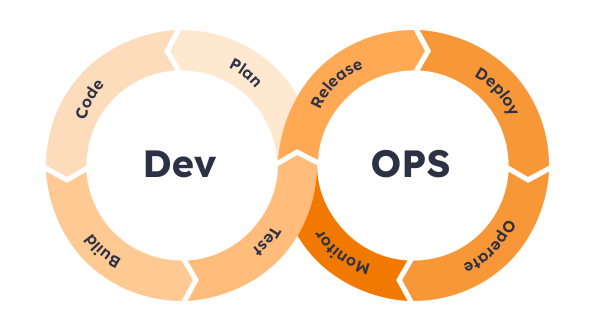
DevOps life cycle diagram
DevOps life cycle phases, explained through Modsen project
There are 8 phases of DevOps life cycle: plan, code, build, test, release, deploy, operate and monitor.
To illustrate how DevOps software development life cycle works in projects, let’s look at a project delivered by Modsen – an AI-powered HR chatbot. AI systems change constantly, so DevOps alone is not enough – they also need MLOps for model updates and AIOps for intelligent monitoring.
Just for context:
MLOps extends DevOps to manage machine learning models – their training, versioning, deployment, and retraining cycles. | AIOps uses AI and analytics to automate and improve IT operations, helping detect issues faster and maintain stable system performance. |
|---|
According to Google. MLOps: Continuous delivery and automation pipelines in ML; Gartner. AIOps Platforms Market Guide (2022).
Below, I break down and explain DevOps life cycle throughout this project.
Plan: Understanding HR workflows and defining AI architecture
In the HR chatbot project, we didn’t start by coding. We began by aligning HR specialists, developers, QA, DevOps engineers (Who is DevOps engineer? Read here), and security experts on:
what types of HR questions the chatbot must handle,
what rules and policies its answers must follow,
how sensitive employee data must be protected (GDPR),
and what architecture allows the system to handle more users without breaking safely.
Everyone plans together → the system can later be delivered and operated without chaos.
Code: Designing AI and backend modules
The chatbot’s backend and AI model were written using strict rules: clean structure, documented API (how systems talk to each other), version control (system for tracking changes), mandatory code review.
How it works for this project:
Clean, well-documented code following internal standards.
Git flow that avoids conflicts and mistakes.
Mandatory code review for quality and security.
Clear API design and versioning from the start.
DevOps requires code to be written in a way that supports automation and safe delivery. If code isn’t structured, DevOps life cycle in software engineering can’t exist.
Build: CI and automated ML pipeline assembly
Every change to the chatbot triggered an automatic build:
CI (continuous integration) pipeline checks dependencies,
unit tests run,
Back end and AI components are packaged into containers (lightweight isolated environments for running code).
DevOps replaces manual work with automation, so the system assembles itself.
Test: Ensuring chatbot correctness and stability
For the HR chatbot, we tested:
Natural language processing (NLP) accuracy (does the model understand HR requests?),
Back end logic,
security and access rules,
integrations with HR systems.
Testing isn’t a final step. It happens on every change. Quality remains high throughout the entire DevOps SDLC life cycle.
Release: Ensuring model quality and compliance
Before shipping a new version of the chatbot, we ran a release checklist:
model accuracy audit,
GDPR compliance verification,
performance and latency checks (the time it takes for the system to respond),
HR validation session (a final HR check of chatbot answers).
Deploy: Zero-downtime deployment of chatbot
The chatbot was deployed via:
automated CI/CD pipelines,
Kubernetes (traffic cop for the containers), handling scaling and stability,
Blue-green deployment (two identical versions of the app – one live, one updated), preventing downtime.
Operate: Maintaining a reliable AI system
Once the project went live, our DevOps team ensured:
stable infrastructure,
proper configuration,
24/7 availability,
smooth scaling when user activity increased.
Delivery is only halfway through. DevOps also covers how the system lives in production.
Monitor: Continuous tracking of model accuracy and system health
After deployment, we continuously monitored:
model accuracy,
chatbot fallback rate,
employee satisfaction signals,
system metrics (CPU, memory, errors).
These insights informed the next improvement cycle: monitoring → new ideas → new improvements → new plan.
That is, DevOps software development process, in which one team is responsible for everything: from the idea to the system working in the real world, and back to improving the idea.
Source: The Modern DevOps Lifecycle (2023); The DevOps Handbook (2021).
Want clearer insights about DevOps?
Our experts will walk you through every detail of life cycle of DevOps and answer all your questions about your project idea or career opportunities.
Dmitry Bunas
Head of DevOps Department



The 7Cs of DevOps life cycle
The 7Cs of DevOps describe the continuous practices that run across all DevOps life cycle stages. They’re not separate steps – they work simultaneously.
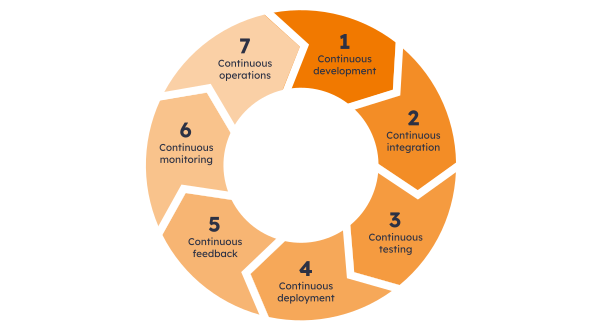
7Cs of DevOps life cycle
Continuous development
This stage covers ongoing planning and coding. Instead of working on one large feature for months, the team breaks the project into small, manageable updates that can be delivered quickly.
For the project, engineers continuously refined intents, HR logic, and NLP components as the chatbot learned from new queries.
Continuous integration
Every time developers commit code, the system automatically checks it, tests it, and integrates it with the rest of the project. This prevents conflicts and catches issues early.
For the project, each update to the chatbot’s backend or AI pipeline triggered automated tests and builds, ensuring the codebase stays stable.
Continuous testing
Tests run automatically throughout the entire DevOps software development life cycle, not only before release. This helps validate new code and detect regressions.
For the project, we continuously tested NLP accuracy, HR policy compliance, and conversation flows.
Continuous deployment
When code passes all tests, it can be deployed automatically to staging or production environments. No manual steps, no delays, no downtime.
For the project, updates to the chatbot were deployed through CI/CD pipelines, using blue-green deployments to avoid service interruption.
Continuous monitoring
The team constantly tracks performance, errors, system health, and user behavior. Monitoring during DevOps life cycle helps detect problems early and maintain high reliability.
For the project, we monitored inference latency, model accuracy, fallback rates, and system load to ensure the chatbot remained stable and responsive.
Continuous feedback
Feedback comes from real users, logs, HR teams, and monitoring systems. It’s used to improve the model, update conversation flows, and refine system behavior.
For the project, HR specialists’ feedback and real employee dialogues helped improve the NLP model and update HR response logic.
Continuous operations
This ensures the system keeps running smoothly without taking it offline for updates or maintenance. Everything – scaling, patching, rollouts – is designed to be seamless.
For the project, Kubernetes handled scaling, redundancy, and self-healing, allowing the HR chatbot to stay available 24/7 with no downtime.
This loop repeated each week during the HR chatbot project, helping the system improve without interruptions. Phases of the DevOps life cycle describe the sequence of actions. The 7Cs describe the continuous practices that run across all phases.
DevOps life cycle phase (What) | Continuous practice (How) |
|---|---|
Plan | Continuous development |
Code | Continuous integration |
Build / Test | Continuous testing |
Release / Deploy | Continuous deployment |
Monitor | Continuous monitoring |
Operate | Continuous operations |
All phases | Continuous feedback |
DevOps life cycle tools & technologies
None of the phases or 7Cs can be achieved manually. That’s why DevOps SDLC life cycle is always supported by a stack of tools that handle all in a consistent way.
In the AI HR chatbot project, these tools were the backbone of our workflow: they allowed us to automate builds, run ML tests, deploy updates without downtime, monitor system performance, and collect feedback for retraining the model.
Phases | Tools |
|---|---|
Continuous development | |
Continuous integration | |
Continuous testing | |
Continuous deployment | |
Continuous monitoring | |
Customer feedback | |
Continuous operations |
What is the take?
The DevOps life cycle is based on continuity – a steady, repeatable rhythm that keeps products evolving instead of decaying. When each phase feeds the next, teams stop fixing the same issues over and over again and start building software that grows stronger with every iteration. It’s this cycle that turns ideas into systems that stay maintainable, scalable, and reliable long after launch.
And if these notes made you wonder, what are the skills required for a DevOps engineer to orchestrate a life cycle like this, we’ve outlined the essentials in a dedicated article – all the requirements which will make you a real expert.
References & further reading
Books
1.
Spain, G. R. (2023). The Modern DevOps Lifecycle: Shifting CI/CD and Application Architectures. Red Hat.
2.
Kim, G., Humble, J., Debois, P., & Willis, J. (2021). The DevOps Handbook: How to Create World-Class Agility, Reliability, and Security in Technology Organizations. O’Reilly Media.
3.
Bass, L., Weber, I., & Zhu, L. (2015). DevOps: A Software Architect’s Perspective. Addison-Wesley.
Academic Sources
4.
Senapathi, M., Buchan, J., & Osman, H. (2019). DevOps Capabilities, Practices, and Challenges: Insights from a Case Study. Journal of Systems and Software, 157, 110395.
5.
Wiedemann, A., & Wiesche, M. (2018). Are You Ready for DevOps? Required Skill Set for DevOps Teams. European Conference on Information Systems (ECIS 2018).
Industry & Practice Reports
6.
Gartner Research. (2022). AIOps Platforms Market Guide. Gartner Inc.
7.
Google Engineering. (2021). MLOps: Continuous Delivery and Automation Pipelines in Machine Learning. Google Cloud Architecture Center.
8.
Modsen Engineering Practice Reports. (2025). Internal case studies and applied frameworks for high-velocity software delivery.

Get a weekly dose of first-hand tech insights delivered directly to your inbox